Views by seeper crew…
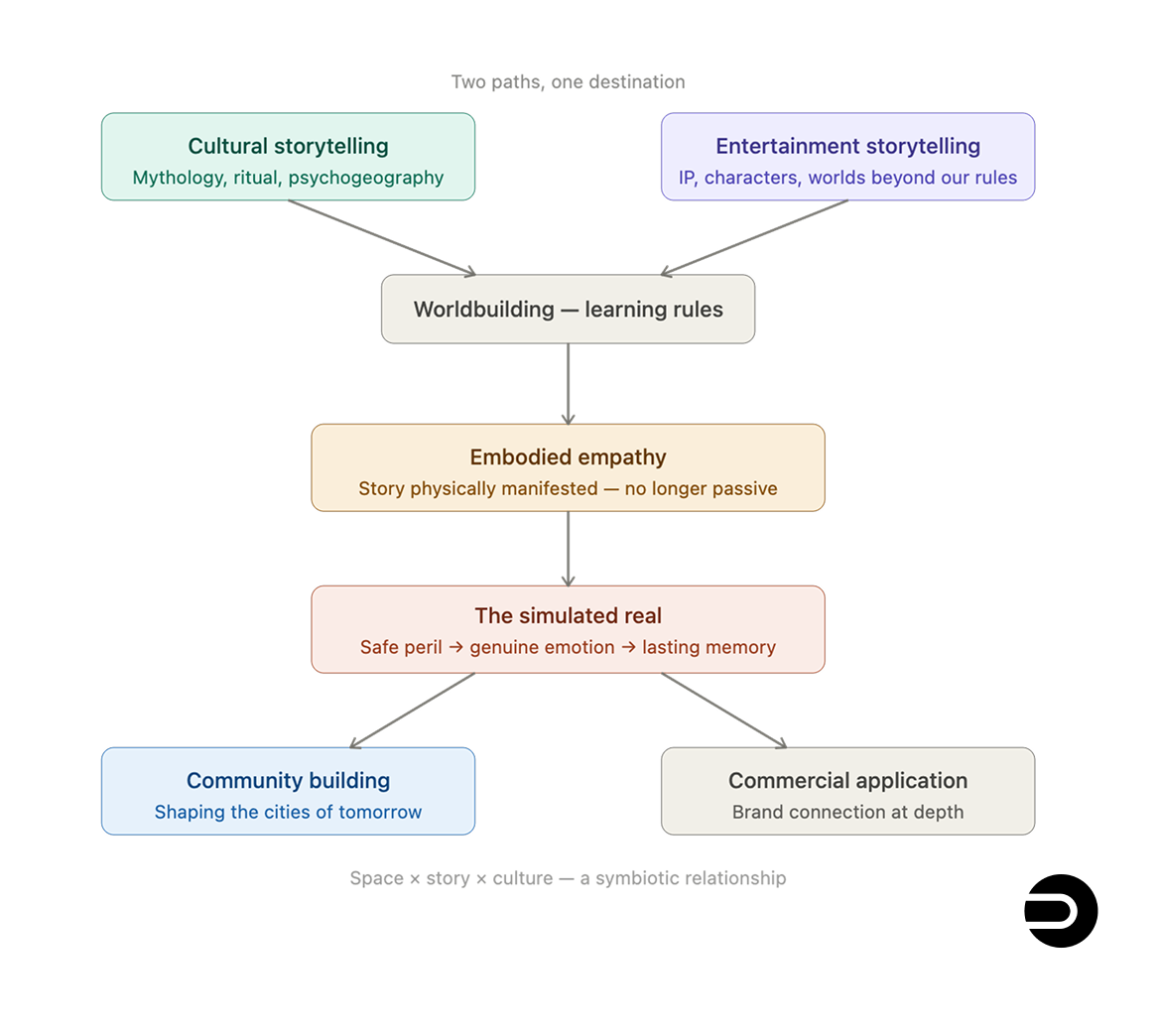
All storytelling, at its core, is about learning rules. Whether a story is cultural or commercial, it asks its audience to inhabit a world with its own logic, a process we call worldbuilding. Spatial storytelling does something different, it makes that world physical, transforming the audience from passive recipients into active participants.
Cultural storytelling and entertainment storytelling appear to serve different ends, but they arrive at the same place. Cultural stories, rooted in mythology, ritual, and the psychogeography of place, teach us the rules of our own community, or invite us into someone else’s. Entertainment stories offer something equally powerful: escapism. The most enduring IPs present characters and communities liberated from the rules and responsibilities that bind us. This is not trivial. Pre-industrial communities looked upon travellers with the same mixture of wonder and longing, sometimes jealousy, someone not anchored by the weight of lifelong obligation. Escapism is enjoyable precisely because it is a release from consequence.
What spatial storytelling adds is embodiment. When a story is built into space, a route, a building, a city block, it can no longer simply be watched. It must be moved through, felt, remembered in the body. This is where empathy deepens, not through observation but through experience. The very best spatial stories are honest about what they are. They acknowledge the simulation and in that acknowledged gap between simulation and reality, something remarkable happens. The boundary blurs. By understanding an audience’s psychology, sensory triggers, and emotional chemistry intimately, we can harmonise the designed experience with the way they already perceive the world. The result is connection at a depth that passive storytelling rarely achieves.
This is a tool that can be used cynically, purely for commercial ends. But it can also be something far more consequential. Spatial storytelling has the power to incubate communities, to weave significance into physical geography, to give shared spaces collective meaning, to shape not just how a place looks but who moves through it, how they move through it and why. Culture is formed by shared experience, and the best shared experiences that foster the deepest human connections are shaped by ritualistic movement through space.
There is, in other words, a symbiotic relationship between space, story, and culture. We have the opportunity to design that relationship deliberately to build the cities of tomorrow by choosing, with care, which stories we weave into their fabric.